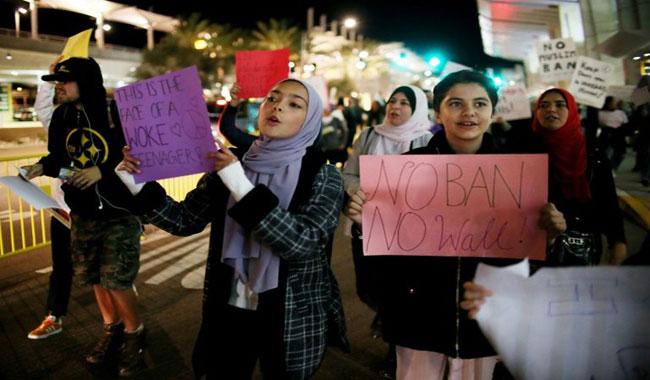
President Trump's revision of his controversial executive order
imposing a travel and refugee ban on certain countries will get an
important legal test on Monday, when a federal appeals court in Virginia
weighs whether the administration overstepped its authority.
At issue is whether the ban violates the Religion
Clause of the First Amendment, the Due Process Clause of the Fifth and
14th Amendments, and the ban on nationality discrimination in the
issuance of immigrant visas contained in a 65-year-old congressional
law.
The case will be a major test of presidential power, especially in the area of immigration.
The White House frames the issue as a temporary move
involving national security. A coalition of groups in opposition call
the order blatant religious discrimination, since the six countries
involved have mostly Muslim populations: Iran, Libya, Somalia, Sudan,
Syria, and Yemen.
Nearly all of the 15 full-time judges on the
Richmond-based 4th Circuit U.S. Court of Appeals are expected to hear
the case in a public oral argument, a move to expedite the issue
eventually to the Supreme Court in coming months for final review. Judge
J. Harvie Wilkinson, a conservative on bench, is expected to recuse
since his son-in-law will be arguing the case for the Trump Justice
Department. A majority of the active bench were nominated by Democratic
presidents.
The Monday hearing will be the first of two appeals
heard this month. The San Francisco-based 9th Circuit will review
similar claims. Split rulings by these courts would mean an almost
certain review by the Supreme Court. A nationwide injunction on
enforcement of the "Executive Protecting the Nation from Foreign
Terrorist Entry into the United States," ordered by federal judges in
Maryland and Hawaii, remains in effect.
The International Refugee Assistance Project, one of
the groups filing lawsuits against the Trump administration, ripped the
order for its impact on refugees.
"The president's discriminatory executive order has
trapped these vulnerable people in life-threatening conditions," said
Rebecca Heller, IRAP's director whose group represents hundreds of
“displaced families from Syria, Iraq, Somalia, and elsewhere."
But the Justice Department in a filing with the
appeals court called the president's action "a temporary suspension of
entry that was done to protect national security and makes no mention of
religion."
"Although plaintiffs and others may believe that the
national-security risk is insufficient to warrant [the order's] entry
suspension," said the government, "the President is entitled and
obligated by the Constitution and Acts of Congress to weigh those risks
himself and to strike a different balance than his predecessors if he
deems it appropriate to protect national security."
This is the White House's second effort to impose a
travel ban. An order issued a week after Trump took office was also
quickly blocked from taking effect. Nationwide protests were held in
many cities and airports.
The administration issued its revised order March 6,
which included removing Iraq from the original list of banned countries.
It also lifted an indefinite ban on Syrian refugees, many fleeing a
years-long civil war there.
Officials say the new executive order only applied to foreign nationals outside the U.S. without a valid visa.
"Unregulated, unvetted travel is not a universal
privilege, especially when national security is at stake," Homeland
Security Secretary John Kelly said at the time.
Senate Minority Leader Chuck Schumer, D-N.Y., said
the latest version was no better than the original, calling the order
"mean spirited and un-American."
A major sticking point for the judicial panel will be
navigating how much discretion the president really has over
immigration. Courts have historically been deferential in this area, and
recent presidents including Jimmy Carter, Ronald Reagan and Barack
Obama have used it to deny entry to certain refugees and diplomats,
including nations such as Iran, Cuba, and North Korea.
A 1952 federal law -- the Immigration and Nationality
Act, passed in the midst of a Cold War fear over Communist influence --
gives the chief executive broad authority.
"Whenever the president finds that the entry of any
aliens or of any class of aliens into the United States would be
detrimental to the interests of the United States, he may, may by
proclamation, and for such period as he shall deem necessary, " says
Section 212 (f) of the law, "suspend the entry of all aliens or any
class of aliens as immigrants or nonimmigrants, or impose on the entry
of aliens any restrictions he may deem to be appropriate."
The administration strongly denies this is a "Muslim
ban," but federal judges cited statements by then-presidential candidate
Trump and his advisers, including a December 2015 campaign press
release calling for "a total and complete shutdown of Muslims entering
the United States."
And challengers to the law say Trump has taken this
power to extremes by banning nearly entire populations from multiple
countries.
The case is International Refugee Assistance Project
v. Trump (17-1351). There was no timetable on how quickly the judges
would issue a ruling, or when it could be appealed to the Supreme Court.
 Phetchaburi: -Not many chefs don a welding
mask before they enter the kitchen, but Sila Sutharat prefers to cook
his chicken sunny side up.